
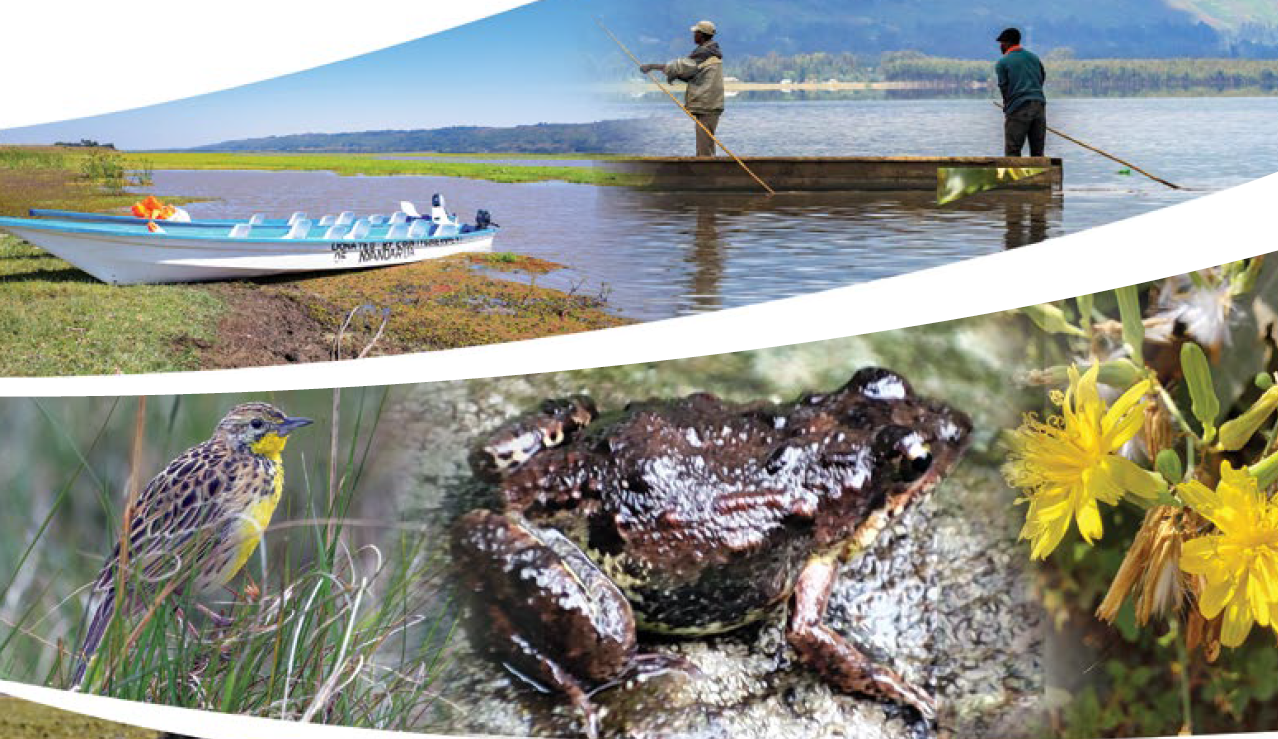
Three landmark studies released this year by the East African Wild Life Society, the Wangari Maathai Institute for Peace and Environmental Studies at the University of Nairobi, and the Wildlife Research and Training Institute have delivered the most comprehensive scientific picture yet of Lake Ol Bolossat, Kenya's only natural highland lake, strengthening the case for its designation as the country's seventh Ramsar Site while sounding a clear warning about the pressures threatening its future.
Nestled in Nyandarua County at 2,340 metres above sea level, Lake Ol Bolossat forms the headwaters of the Ewaso Ng'iro North River, sustaining water supplies, pasture, fisheries and tourism for more than two million people across Nyandarua, Laikipia, Samburu, Isiolo and Wajir counties. Already recognised as an Important Bird and Biodiversity Area and a Key Biodiversity Area, the lake has for decades been earmarked by the Government of Kenya as a priority wetland for Ramsar designation, but the process had stalled for want of reliable biodiversity data.
That gap has now been filled. The Lake Ol Bolossat Rapid Biodiversity and Socio-economic Assessment Report, and its companion Lake Ol Bolossat Rapid Biodiversity and Socio-economic Assessment Summary Report,present findings from a nine-day multi-taxa survey conducted under the project "Unlocking Biodiversity Data to Facilitate Designation of Lake Ol Bolossat as the 7th Ramsar Site in Kenya," funded by the JRS Biodiversity Foundation. The survey recorded 518 plant species, 278 fungal species, 206 invertebrates, 162 bird species, 17 amphibians and reptiles, seven mammal species and 126 individual hippopotamuses. Discoveries included two plants never before recorded in Kenya, one possibly a first record for Africa; a fungus previously unknown in the country; and several grasshoppers and frogs found nowhere else on earth. Twenty-four bird species of conservation concern were documented, among them the endangered Grey Crowned Crane and Sharpe's Longclaw, alongside twenty Palearctic migrant species.
Yet the same studies expose a wetland under mounting strain. Satellite imagery spanning five decades shows tussock grasslands vital to breeding birds have shrunk by over 10,000 hectares since 1973, forest cover has more than halved, and the landscape has fragmented sixty-five-fold as farmland, eucalyptus plantations and settlements have crept into the catchment. Encroachment, pollution, invasive species such as Salvinia molesta, uncontrolled water abstraction, and illegal hunting were all identified as significant threats, compounded by weak governance and unclear lake boundaries.
A companion study, the Management Effectiveness Assessment of Lake Ol Bolossat Ecosystem, conducted using the globally recognised Management Effectiveness Tracking Tool, found that overall management effectiveness stands at just 41.46 percent. While planning frameworks scored relatively well, outputs were weak and outcomes critically poor, at only 8.33 percent, pointing to a wide gap between policy and results. Despite the lake's status as a Wetland Protected Area since 2018 and a Catchment Protected Area since 2023, enforcement remains inadequate, staffing and financing insufficient, and community awareness of the Integrated Management Plan low, with only 17 percent of surveyed households aware of its existence.
Drawing these findings together, the policy brief From Evidence to Action: Advancing the Conservation and Sustainable Management of Lake Ol Bolossat Ecosystem calls for fast-tracking gazettement of the lake as a National Reserve, accelerating Ramsar designation, establishing a transboundary governance body linking the five dependent counties, fully funding the Integrated Management Plan, restoring degraded habitats, and building sustainable financing through payment for ecosystem services and community-led ecotourism.
Together, the reports show Lake Ol Bolossat remains a wetland of exceptional value, one whose decline would carry consequences far beyond Nyandarua's borders. As Kenya works toward listing the lake as its seventh Ramsar Site, its partners are calling for the sustained investment and enforcement this ecosystem urgently needs.